Discount Texturing: Concepts and Techniques (Graphics Series) :>>> limited time offer!
If you are a freelance professional or a student of 3D you are going to find this book very useful. Every year I have to review several books to try to find a teaching tool that is clear and concise. This book hit the spot.
The book fills two vital needs. Not only will you learn to use the color and lighting tools in your program, but if you need to get up to speed on the other software packages that are covered, this book is the answer. The book covers Maya, 3D Studio Max and Lightwave!
If you work for various clients you will find this is a great reference to help get going regardless of software used in most of the production studios you would encounter. If you are a student or have just graduated, this is a wonderful tool to keep handy and help convert from one package to another, fast. There is just enough background or theory to let you understand what you are doing with the tools, as well as actual useful examples that reinforce the instructions in the book. But, wait, that is not enough, what I really appreciate, is that Mr. Summers actually talks about the "Gotchas" and traps that seem to be inherent in all 3D packages. These are the little undocumented software "features" that usually take hours or days of experimentation, e-mails to colleagues, or digging through the underbelly of the internet, to uncover or understand.
Now two things that bother me about the book, and hence the four stars instead of five, are the name of the book and the errors found in it. Now, the errors are all minor and I never found an error that was so bad as to make a lesson unusable (like I have found in so many other books and online tutorials), but I would believe that by now publishers should be able to find good technical editors. Which leads me to the title.
The title just does not do justice to the material. There is so much more in the book then just texturing. I find the book more of a good instructional manual or reference for color and lighting in general. For example, in one lesson Mr. Summers covers not only how to use and make layered textures, but also how to create and control displacement maps and backgrounds, without being overwhelming, dryly technical, or worse, confusingly abbreviated, like so many online tutorials.
The book is not a guide on how to paint textures, there are plenty of... well I call them "efforts" to cover that arena. I suggest you find a way to carefully review those books if that is what you are after. Instead, Mr. Summers has provided a way to form that mental map of the software that will allow you to use it or learn it effectively. In today's fast paced job market and in the everchanging academic environment, this could be the edge you need to succeed.
Texturing: Concepts and Techniques (Graphics Series) Overview
The Texturing Rosetta Stone!
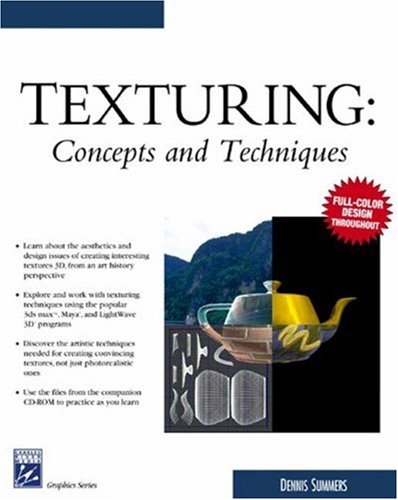
Texturing: Concepts and Techniques is a detailed guide to the aesthetics and design issues of creating interesting textures for digital art and 3D animation. This beautifully-illustrated, four color book teaches artists how to create stunning and convincing textures, and helps them understand the limitations that 3D animation places on creating quality imagery. It details the artistic techniques behind creating convincing textures, not just realistic or photorealistic ones, by explaining how to make viewers believe your images’ message.
The book is written for digital 3D artists who want to hone their texturing skills, and learn the "why" behind the techniques and tools. By understanding how and why surface textures are created, you’ll be able to create better work, and you’ll be prepared to solve an array of potential challenges. Each chapter provides a theoretical look at an issue and includes in-depth tutorials as needed. The tutorials and techniques don’t just show you how to recreate a texture, they take you deep into the tools of the programs so you really understand how and why they work. Although each tutorial is done using 3ds max™, LightWave 3D®, and Maya®, the concepts apply generally to almost any application. These three programs were chosen because they cover three different approaches to interface design, and they are used by a majority of 3D users.
Each product specific tutorial is highlighted with a different color, so you can quickly find your application. And the tutorials are written similarly, so that you can easily pick out the differences between the applications and get up to speed quickly on those new to you. Even if you always use your favorite program, it doesn’t hurt to see how the other programs do it. Most studios use multiple tools, so it can only help you to know how they all work! You will be far more powerful when you can assess a given project and determine which software will be the easiest, fastest, or give you the best results. By mastering the concepts and techniques presented here, you’ll learn to create convincing textures that will make your photorealistic and fantasy designs believable!
KEY FEATURES
* Provides practical coverage of lighting, post-production, and rendering, and shows how they work so intricately with texturing
* Details the differences between 3ds max, Maya, and LightWave, and helps you get up to speed quickly when switching programs
* Provides in-depth coverage of the concepts and software needed to create textures
* Exposes you to broader issues of creating "convincing" visual environments
* Includes a companion CD-ROM with all of the files necessary to complete the tutorials in the book
ON THE CD!
* Learn about the aesthetics and design issues of creating interesting 3D textures from an art history perspective
* Explore and work with texturing techniques using the popular 3ds max™, Maya®, and LightWave 3D® programs
* Discover the artistic techniques needed for creating convincing textures, not just photorealistic ones
* Use the files from the companion CD-ROM to practice as you learn
SYSTEM REQUIREMENTS
You should have one of the 3 software tools covered in the book, 3ds max 6, Lightwave 7.5, or Maya. Please check your software for specific requirements. Some minimum requirements to run these tools include: PC: Intel® Pentium® II or higher, AMD Athlon® processor, 512MB RAM, CD-ROM Drive, Hardware- Accelerated OpenGL® graphics card, 3-button mouse with mouse driver software, 450MB of hard disk space, Windows 2000, Windows NT 4 (Service Pack 6a), Windows XP Home/Professional, TCP/IP Network Protocol installed, 128MB of available RAM, 32MB Available hard drive space, CDROM drive for installation, and a minimum screen resolution of 800 x 600 pixels. MACINTOSH: (LightWave and Maya only) Power Macintosh processor (G3 or higher recommended), Mac OS X recommended, 128 MB of available RAM for OS X, 32MB available hard drive space, CD-ROM drive for installation, and a minimum screen resolution of 800 x 600 pixels. Please note that there is limited support for Lightwave and Maya on the Macintosh, so we cannot guarantee 100% compatibility with the tutorial files if they are used on a Macintosh.
Buy Texturing: Concepts and Techniques (Graphics Series) at Lowest Prices & Fast Shipping! Decide Now! :>>> limited time offer!
*** Product Information and Prices Stored: Jul 15, 2010 22:30:08